





















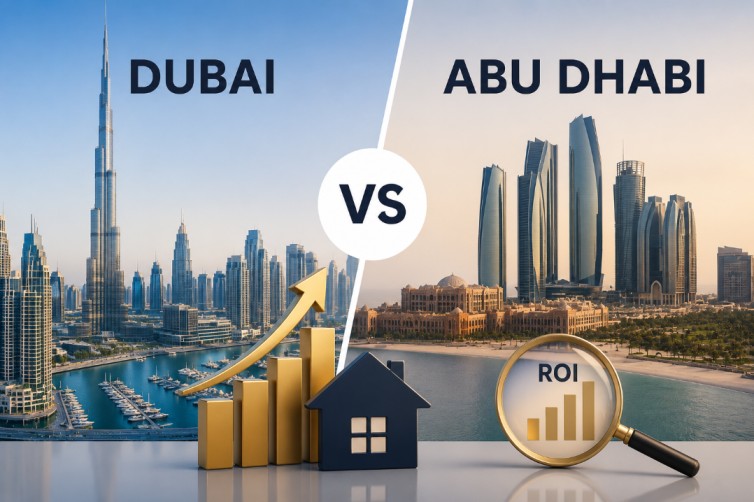
The UAE remains one of the world’s most closely watched real estate markets, attracting investors from across the globe.
But when investors compare Dubai and Abu Dhabi, the conversation often comes down to two questions:
“Where will my property appreciate more?”
and
“Where will I get the better return on investment?”
These questions sound similar, but they are actually asking about two different things.
Capital appreciation measures how much the value of your property increases over time.
Rental ROI measures the income your property generates from rent relative to the amount you invested.
An investor buying a property in Dubai may be targeting strong capital appreciation and high liquidity, while another investor choosing Abu Dhabi may be more interested in rental income, long-term stability, or investing in a specific emerging community.
The reality is that there is no universal answer to whether Dubai or Abu Dhabi offers the “best” investment.
The right choice depends on:
- Your investment budget
- Your investment horizon
- Your target rental income
- Your appetite for risk
- Your preferred property type
- Your exit strategy
- Your preference for established or emerging communities
In this guide, we break down the difference between capital appreciation and ROI and compare the Dubai and Abu Dhabi property markets to help investors make a more informed decision
What Is Capital Appreciation in Real Estate?
Capital appreciation is the increase in the market value of a property over time.
For example, imagine you purchase an apartment for:
Purchase price: AED 2,000,000
Five years later, the property’s market value becomes:
AED 2,500,000
Your gross capital appreciation is:
AED 500,000
Or:
25% increase in property value
The calculation is:
Capital Appreciation = Current Property Value – Original Purchase Price
To calculate the percentage:
Capital Appreciation % = (Increase in Value ÷ Original Purchase Price) × 100
In this example:
AED 500,000 ÷ AED 2,000,000 × 100 = 25%
However, investors should remember that capital appreciation is not the same as profit.
You may still need to account for:
- Purchase costs
- Registration fees
- Agency commission
- Mortgage costs
- Selling costs
- Service charges
- Maintenance
- Property management expenses
Therefore, the actual net profit from selling a property can be lower than the headline increase in market value.
What Is Rental ROI?
Rental ROI, commonly referred to as rental yield, measures the income a property generates from rent.
For example:
Purchase price: AED 2,000,000
Annual rent: AED 120,000
Gross rental yield:
AED 120,000 ÷ AED 2,000,000 × 100 = 6%
This means the property generates a gross rental yield of approximately 6% before expenses.
However, gross yield is not the same as net ROI.
You may need to deduct:
- Service charges
- Property management fees
- Maintenance
- Insurance
- Vacancy periods
- Leasing costs
- Mortgage interest, if applicable
For example:
Annual rent: AED 120,000
Annual expenses: AED 25,000
Net rental income: AED 95,000
Net rental yield:
AED 95,000 ÷ AED 2,000,000 × 100 = 4.75%
This is why investors should always ask:
“Is that gross ROI or net ROI?”
The difference can be significant.
Capital Appreciation vs Rental ROI: Which Is More Important?
The answer depends on your investment strategy.
Consider two investors.
Investor A: Capital Growth Strategy
Investor A buys a property for AED 2 million.
After five years, the property is worth AED 2.6 million.
The investor has achieved AED 600,000 in capital appreciation.
They may have received rental income during the five-year holding period as well.
Their strategy is focused on:
Buy → Hold → Appreciate → Sell or Refinance
Investor B: Income Strategy
Investor B purchases a property for AED 2 million.
The property generates AED 120,000 in annual rent.
The investor’s priority is:
Buy → Rent → Generate Cash Flow → Hold Long Term
Neither strategy is necessarily better.
Investor A may achieve stronger overall returns if the property appreciates significantly.
Investor B may benefit from predictable income and long-term cash flow.
The strongest investments can potentially combine both:
Capital appreciation + Rental income
This is often referred to as total investment return.
What Is Total ROI?
A property’s total return can come from several sources:
- Rental income
- Capital appreciation
- Potential leverage through financing
- Tax efficiency, depending on the investor’s circumstances
- Potential residency benefits, where applicable
For example, suppose you purchase a property for AED 2 million.
Over five years:
Capital appreciation: AED 400,000
Total rental income received: AED 600,000
Your combined gross return before expenses is:
AED 1 million
This represents a 50% gross return on the original purchase price over five years.
However, this is a simplified example.
A professional investment analysis should also consider:
- Acquisition costs
- Financing costs
- Service charges
- Maintenance
- Vacancy
- Property management
- Selling costs
- Taxes or obligations in the investor’s home country
The key takeaway is simple:
Don’t evaluate a property based only on rental yield or only on expected appreciation.
Look at the complete investment picture.
Dubai vs Abu Dhabi Real Estate: The Big Picture
Dubai and Abu Dhabi are both major UAE real estate markets, but they have different characteristics.
Dubai is globally recognised for its:
- International population
- Tourism sector
- Business ecosystem
- Large off-plan market
- Luxury property segment
- High transaction activity
- Extensive international investor base
Abu Dhabi, meanwhile, has a different economic foundation.
The capital is supported by:
- Government institutions
- Energy and industrial sectors
- Sovereign investment activity
- Financial services
- Education
- Healthcare
- Culture and tourism
- Major infrastructure investment
This creates two distinct real estate investment environments.
Dubai is often associated with high liquidity, global demand, and strong market activity.
Abu Dhabi is increasingly associated with long-term urban development, premium communities, lifestyle destinations, and a growing investment ecosystem.
Neither market should be viewed as a simple “winner.”
The better choice depends on your objectives.
Dubai vs Abu Dhabi: Capital Appreciation
Capital appreciation depends heavily on the specific property and location.
Comparing the two emirates at a broad level can be misleading.
For example, a luxury waterfront apartment in Dubai Marina may behave very differently from an apartment in an emerging Dubai community.
Similarly, a premium property on Saadiyat Island may have a completely different investment profile from a property in another Abu Dhabi neighbourhood.
The real question is:
Which community has the strongest combination of demand, supply, infrastructure, lifestyle, and future development?
Dubai’s Capital Appreciation Potential
Dubai’s global appeal can support strong demand from:
- International investors
- High-net-worth individuals
- Expats
- Entrepreneurs
- Business owners
- Tourists
- Long-term residents
The city’s large-scale infrastructure and continuous development also create opportunities for investment across different price segments.
However, Dubai is also a highly active development market.
Investors need to consider:
- New project supply
- Competition between developments
- Market cycles
- Service charges
- Entry price
- Resale liquidity
A property that is popular today may face increased competition from new developments tomorrow.
Therefore, investors should avoid assuming that every Dubai property will appreciate at the same rate.
Abu Dhabi’s Capital Appreciation Potential
Abu Dhabi’s property market has been evolving rapidly.
The emirate is investing heavily in:
- Tourism
- Culture
- Entertainment
- Infrastructure
- Waterfront destinations
- Luxury hospitality
- Residential communities
Major destinations such as Saadiyat Island, Yas Island, Al Reem Island, and Hudayriyat Island are becoming increasingly important to the emirate’s real estate strategy.
Saadiyat Island, for example, benefits from its combination of:
- Luxury residential developments
- Cultural institutions
- Beach lifestyle
- Hospitality
- Tourism
- International attractions
Yas Island combines:
- Entertainment
- Theme parks
- Hospitality
- Retail
- Dining
- Residential communities
Al Reem Island has developed into one of Abu Dhabi’s major urban residential destinations.
Hudayriyat Island represents a newer phase of large-scale lifestyle and waterfront development.
These types of destinations can create long-term opportunities for investors who are willing to take a longer-term view.
Dubai vs Abu Dhabi: Rental ROI
Rental ROI is another area where investors often compare the two markets.
However, rental yields vary significantly depending on:
- Location
- Property size
- Property type
- Purchase price
- Furnishing
- Building quality
- Service charges
- Tenant demand
A small apartment in a high-demand area may produce a higher gross yield than a luxury villa.
A premium property may generate lower rental yield but offer stronger long-term capital appreciation.
Therefore, investors should not simply ask:
“Does Dubai have higher rental yields?”
or
“Does Abu Dhabi have higher rental yields?”
The better question is:
“Which specific property offers the best risk-adjusted return for my investment strategy?”
An Illustrative ROI Comparison
Let’s consider two hypothetical properties.
These figures are illustrative examples only, not market forecasts or guaranteed returns.
Example A: Dubai Apartment
Purchase price: AED 1,800,000
Annual rent: AED 108,000
Gross rental yield:
108,000 ÷ 1,800,000 × 100 = 6%
Assume annual operating costs of AED 18,000.
Net rental income:
AED 90,000
Approximate net rental yield:
5%
Example B: Abu Dhabi Apartment
Purchase price: AED 1,800,000
Annual rent: AED 117,000
Gross rental yield:
117,000 ÷ 1,800,000 × 100 = 6.5%
Assume annual operating costs of AED 20,000.
Net rental income:
AED 97,000
Approximate net rental yield:
5.39%
In this simplified example, the Abu Dhabi property produces a slightly higher net rental return.
But does that automatically make it the better investment?
Not necessarily.
You still need to consider:
- Expected capital appreciation
- Vacancy risk
- Resale liquidity
- Tenant demand
- Service charges
- Future supply
- Location quality
- Exit strategy
The best investment is the one with the strongest overall risk-adjusted return, not necessarily the highest advertised rental yield.
Dubai vs Abu Dhabi: Which Has Better Liquidity?
Liquidity refers to how easily you can sell an asset without significantly reducing its price.
Dubai generally has a very large international buyer pool.
This can create strong liquidity for properties in established, high-demand locations.
International buyers are familiar with communities such as:
- Downtown Dubai
- Dubai Marina
- Palm Jumeirah
- Business Bay
- Jumeirah Village Circle
Abu Dhabi’s buyer pool is also expanding, particularly in areas such as:
- Saadiyat Island
- Yas Island
- Al Reem Island
- Al Raha Beach
However, the size and depth of the market can vary significantly from one community to another.
For investors who prioritise the ability to sell quickly, the specific location and property type may matter more than the emirate itself.
Dubai vs Abu Dhabi: Off-Plan Investment
Both emirates offer off-plan investment opportunities.
Dubai has a highly active off-plan market, with investors often attracted by:
- Developer payment plans
- New master communities
- Early-stage pricing
- New launches
- Potential capital appreciation
Abu Dhabi’s off-plan market is also becoming increasingly attractive, particularly in major master-planned destinations.
Developments across:
- Saadiyat Island
- Yas Island
- Al Reem Island
- Hudayriyat Island
are attracting interest from both local and international buyers.
For off-plan investors, however, the developer is extremely important.
Before buying, consider:
- Developer track record
- Project registration
- Escrow arrangements
- Construction progress
- Payment plan
- Handover date
- Service charges
- Resale conditions
Do not buy an off-plan property simply because the payment plan appears attractive.
The developer, location, project quality, and long-term demand are often more important than the initial discount.
Dubai vs Abu Dhabi for Long-Term Investors
For investors with a 7-to-10-year horizon, both markets can offer compelling opportunities.
Dubai may appeal to investors seeking:
- International demand
- High transaction activity
- Global brand recognition
- Tourism-driven rental demand
- Large off-plan selection
- High liquidity in established areas
Abu Dhabi may appeal to investors seeking:
- Long-term urban development
- Government-backed infrastructure investment
- Premium lifestyle destinations
- Cultural and tourism growth
- Waterfront communities
- A potentially less speculative investment environment in selected locations
Again, these are broad characteristics.
The actual investment outcome depends on the property you purchase.
Which Is Better for Capital Appreciation: Dubai or Abu Dhabi?
There is no guaranteed answer.
If you are looking for capital appreciation, you should focus on the next stage of development.
Ask:
- Is the population growing?
- Is employment increasing?
- Is infrastructure improving?
- Are major attractions opening?
- Is the area becoming more desirable?
- Is supply controlled?
- Is the property positioned well within the community?
For example, a property located near a major new cultural, entertainment, or lifestyle destination may benefit from increased demand over time.
But the investment should still be evaluated against its purchase price.
Buying in a great location at an excessive price can still produce a poor investment.
Which Is Better for Rental ROI: Dubai or Abu Dhabi?
Again, the answer depends on the property.
A small apartment in a high-demand Dubai location may generate an attractive rental yield.
A property in an Abu Dhabi community with strong demand from professionals and families may also produce competitive rental income.
Investors should compare:
Net rental yield + expected capital appreciation + liquidity + risk
rather than focusing on rental yield alone.
For example:
Property A
Gross yield: 7%
Expected appreciation: Low
Liquidity: Moderate
Property B
Gross yield: 5%
Expected appreciation: Strong
Liquidity: High
Depending on the investor’s objectives, Property B could potentially deliver a stronger total return over the long term.
This is why a 5% rental yield is not automatically worse than a 7% rental yield.
Dubai vs Abu Dhabi: A Practical Comparison
| Investment Factor | Dubai | Abu Dhabi |
|---|---|---|
| International investor demand | Very strong | Strong and growing |
| Tourism-driven demand | Very strong | Growing rapidly |
| Off-plan market | Highly active | Expanding |
| Market liquidity | High in prime areas | High in established prime areas |
| Luxury property market | Very strong | Strong, particularly in prime destinations |
| Rental demand | Strong | Strong in key communities |
| Capital appreciation | Location and cycle dependent | Location and cycle dependent |
| Emerging communities | Many | Several major master developments |
| Lifestyle investment | Very strong | Increasingly strong |
| Cultural investment | Strong | Major strategic focus |
| Long-term development | Extensive | Extensive |
| Best suited for | Global investors, active investors, diversified strategies | Long-term investors, lifestyle-focused buyers, premium and emerging destinations |
The Real Estate Investment Strategy That May Work Best
Instead of choosing between Dubai and Abu Dhabi, some investors may consider diversifying across both markets.
For example:
Strategy 1: Income Focus
Invest in a property with strong existing rental demand.
Priority:
Net rental income
Strategy 2: Growth Focus
Invest in an emerging or rapidly developing community.
Priority:
Capital appreciation
Strategy 3: Balanced Strategy
Choose a property that offers:
- Reasonable rental yield
- Strong location
- Potential capital appreciation
- Good resale demand
Priority:
Total return
Strategy 4: Portfolio Strategy
Invest across different properties or markets.
For example:
- One property focused on rental income
- One property focused on capital growth
This approach may help reduce dependence on a single investment strategy.
Common Questions Investors Ask
Is Dubai property better than Abu Dhabi property?
Not necessarily.
Dubai may offer stronger global liquidity and a larger international investor market, while Abu Dhabi offers opportunities in major lifestyle, cultural, and waterfront developments.
The right choice depends on the property and your objectives.
Which city has higher ROI?
There is no single ROI figure for either emirate.
ROI varies by property, location, purchase price, rental income, operating costs, and capital appreciation.
Where should I invest for capital appreciation?
Look for locations with strong fundamentals, improving infrastructure, growing demand, and limited or well-managed supply.
Do not invest based solely on past price growth.
Where should I invest for rental income?
Focus on locations with strong tenant demand and compare the net rental yield after service charges and other expenses.
Is off-plan better for capital appreciation?
It can offer potential upside, particularly if the property is purchased at an attractive entry price in a high-demand development.
However, appreciation is not guaranteed.
Is a ready property better for ROI?
It may be better for investors who prioritise immediate rental income.
You can see the property, assess the actual market rent, and potentially begin generating income sooner.
Should I buy in Dubai or Abu Dhabi for a 10-year investment?
Both can be considered.
The decision should be based on:
- Investment budget
- Property type
- Location
- Expected rental income
- Capital appreciation potential
- Liquidity
- Exit strategy
Is a high rental yield always a good investment?
No.
A high yield can sometimes reflect higher risk, weaker liquidity, older buildings, higher maintenance costs, or lower capital appreciation potential.
Always look at the risk-adjusted total return.
Our View: Dubai vs Abu Dhabi in 2026
The UAE real estate market should not be viewed as a competition between Dubai and Abu Dhabi.
Both emirates are developing into global destinations, but they are doing so in different ways.
Dubai has built a powerful global brand around:
Business + Tourism + Luxury + Entertainment + International Investment
Abu Dhabi is building its own distinctive proposition around:
Stability + Culture + Lifestyle + Infrastructure + Long-Term Development
For investors, this creates different opportunities.
If you are looking for a highly liquid market with a broad range of investment options and strong international visibility, Dubai may be attractive.
If you are looking for premium lifestyle destinations, major cultural investment, waterfront communities, and long-term urban development, Abu Dhabi deserves serious consideration.
The most important factor, however, remains the individual property.
A good property in Abu Dhabi can outperform a poor investment in Dubai.
A well-selected Dubai property can outperform a poorly selected Abu Dhabi property.
The city matters. The community matters. The developer matters. The property matters. And, most importantly, the price you pay matters.
Final Verdict: Capital Appreciation or ROI?
If your priority is capital appreciation, focus on locations with strong future growth drivers and buy at a sensible entry price.
If your priority is rental ROI, focus on properties with strong tenant demand and calculate the net yield after all costs.
If you want both, look for properties that offer a balance of:
Rental income + Capital appreciation + Liquidity
When comparing Dubai and Abu Dhabi, don’t ask:
“Which city is better?”
Ask:
“Which property gives me the best risk-adjusted total return for my investment goals?”
That is the question that can lead to a much better investment decision.
Looking for Property Investment Opportunities in Abu Dhabi?
At Providential Properties, we help investors explore carefully selected real estate opportunities across Abu Dhabi’s established and emerging communities.
Whether your priority is capital appreciation, rental income, Golden Visa eligibility, portfolio diversification, or long-term wealth creation, our team can help you compare opportunities based on your investment objectives.
Explore opportunities across destinations including Saadiyat Island, Yas Island, Al Reem Island, Al Raha Beach, Hudayriyat Island, and other key Abu Dhabi communities.
Contact Providential Properties today to discuss your UAE real estate investment strategy.
Disclaimer: This article is for general informational purposes only and should not be considered financial or investment advice. Property prices, rental yields, capital appreciation, and market conditions can change. Illustrative examples are not guarantees of future returns. Investors should conduct independent due diligence and seek professional financial and legal advice before making an investment decision.
